Minggu, 21 April 2013

25 Features of Outstanding ICT Lessons


What should you look for in an ICT lesson? What would make an ICT lesson wonderful, as opposed to boring? The following list comprises the sort of thing I love to see.
It's not just about the technology...
  1. The lesson forms part of a unit which forms part of a scheme of work.
  2. The subject matter of the lesson is interesting and useful, not chosen solely for examination purposes.
  3. There is a good starter activity, one that gets the pupils settled down and in the right frame of mind to do the work the teacher has planned for them. (Read Why Are ICT Lessons Boring? The Start of the Lesson.)
  4. The teacher spends time at the start letting pupils into the “secret” of what the objectives (intended learning outcomes) of the lesson are, ie what is intended to be achieved by the end, and how this lesson fits in with the preceding and following lessons.
  5. There is a good pace to the lesson, even where pupils are working on projects and not being “taught from the front”.
  6. Pupils are given open‑ended tasks (as far as possible), or at least not tasks with a glass ceiling. (Even lessons designed to impart a set of skills can still be more interesting than “drill & practice”).
  7. There are plenty of resources for the pupils to use, enabling the teacher to give quality guidance, ie not confined to mundane tasks such as explaining how to save the document. Such resources will include “how to” guides and posters, on‑screen help (which the pupils will have been taught how to use), and each other.
  8. Ample time is allowed for the plenary, thereby allowing it to be somewhat more useful than the POLO model: Print Out and Log Off. The plenary is an essential part of the lesson, used to check what learning has taken place, consolidate learning, and prepare pupils for the next stage. In fact, a lesson might have two or three plenaries rather than just one at the end.
  9. Homework is set in order to consolidate and extend the pupils’ understanding of the work they have been doing in lessons. (See The Case For Homework in ICT.)
  10. A range of technology is available, and pupils are able to use it when they need to.
  11. Pupils are given plenty of time with the technology, with the teacher helping individuals and small groups.
  12. The teacher makes great use of the technology, including Learning Platforms, visualisers, interactive whiteboards and digital cameras.
  13. The teacher is brimming with enthusiasm!
  14. The teacher is flexible, able to go with the flow of what’s happening right here and now in the classroom, not slavishly following the lesson plan.
  15. Work is set at an appropriate standard, taking into account the pupils’ prior learning and attainment, and what is expected of their age group in terms of national standards.
  16. There is a lot of questioning – probing questioning – and assessment for learning techniques are in evidence.
  17. There is a good range of material to provide for differentiation (higher attainers and children with special educational needs) and personalised learning.
  18. The teacher is aware of individual pupils’ needs, and makes use of the assessment and other data she has – remember: data only becomes information if you do something with it!
  19. Not all work takes place at a computer: there is ample opportunity for discussion and reflection. What is important is not the use of technology per se, but the appropriate use of technology.
  20. Pupils respect the equipment and the room. For example, they do not leave discarded print‑outs on the floor.
  21. Pupils are happy and confident enough to try out things which the teacher has not actually shown them: they ask help from each other or look at the posters and manuals that are available for them.
  22. Pupils keep looking at the clock on the wall, because they want to get to a certain point in their work before the end of the lesson. They have a sense of urgency.
  23. Pupils want to continue working at lunchtime and other non-lesson times.
  24. Pupils want to show off little tricks they have discovered, such as keyboard shortcuts.
  25. Pupils ask questions that the teacher is unable to answer.

Selasa, 09 April 2013

RICARDO KAKA


Kaká was born to Simone Cristina dos Santos Leite and Bosco Izecson Pereira Leite. He has a younger brother, Rodrigo (known as Digão), who has followed in Kaká's footsteps by playing football for Milan.
He suffered a career-threatening and possibly paralysis-inducing spine fracture at the age of 18 as a result of a swimming pool accident, but remarkably made a full recovery. He attributes his recovery to God and since tithed his income to his church.

A devout evangelical Christian, Kaká became engrossed in religion at the age of 12: "I learnt that it is faith that decides whether something will happen or not." He removed his jersey to reveal an "I Belong to Jesus" T-shirt and openly engaged in prayer moments after the final whistle of Milan's 2007 Champions League triumph. Kaká previously sported the same shirt during Milan's 2004 Scudetto celebration and after Brazil's defeat of Germany in the 2002 World Cup final, and had the same phrase, along with "God Is Faithful," stitched onto the tongues of his boots.During the postmatch celebration following Brazil's 4–1 win over Argentina in the 2005 FIFA Confederations Cup final, he and several of his teammates, among them backup keeper Gomes and defender Lúcio, wore T-shirts with "Jesus Loves You" printed on them in various languages.

Kaká is a member of the organization Atletas de Cristo ("Athletes of Christ"). His goal celebration consists of him pointing to the sky as a gesture of thanks to God, and he is proud that he was a virgin when he married. His favorite music is gospel music,and his favorite book is the Bible. Since November 2004, he has served as an Ambassador Against Hunger for the United Nations' World Food Programme, the youngest to do so at the time of his appointment.

Kaká was sworn in as an Italian citizen on February 12, 2007.He features prominently in Adidas advertising and also has a modeling contract with Armani, but the latter prevented him from appearing in a photo collection alongside his Milan teammates that was published by Dolce & Gabbana in early 2007. He married his childhood sweetheart Caroline Celico on 23 December 2005 at the evangelical Reborn in Christ Church in São Paulo, Brazil. Caroline is currently pregnant with their first child.

The Reborn in Christ Church, of which Kaká is a member, is currently under investigation in connection with its leaders, Estevam Hernandes Filho and Sonia Hernandes, who were sentenced to prison in August 2007 on money smuggling charges. Kaká, who has not been charged, was an annual donor to the church with contributions totaling nearly $1 million. He was sent a questionnaire by Brazilian authorities inquiring about connections with the leaders, but his spokesman denied that Kaká had actually received any such documents.

Kaká began his club career with São Paulo at the age of eight. He signed a contract at 15 and led the SPFC youth squad to Copa de Juvenil glory. Kaká made his senior side debut in January 2001 and scored 12 goals in 27 appearances, in addition to leading São Paulo to its first and only Torneio Rio-São Paulo championship. He scored 10 in 22 matches the following season, and by this time his performance was soon attracting attention from European clubs.
AC Milan, fresh from winning the 2003 Champions League, brought him aboard in 2003 for $8.5 million, a fee described in hindsight as "peanuts" by club owner Silvio Berlusconi.Within a month, he cracked the starting lineup, and has remained there since. His Serie A debut was in a 2–0 Milan win at A.C. Ancona. He scored 10 goals in 30 appearances that season, as Milan won the Scudetto and the European Super Cup.

Kaká was a part of the five-man midfield in the 2004–05 season, usually playing in a withdrawn role behind striker Andriy Shevchenko. He scored 7 goals in 36 domestic appearances as Milan finished runner-up to Juventus. Despite Milan losing the 2004–05 Champions League final to Liverpool F.C. on penalties, he was nonetheless voted the best midfielder of the tournament, and also finished ninth, with 19 votes, in the running for the 2005 Ballon D'Or.

The 2005–06 season saw Kaká score his first hat-tricks in domestic and European competition. On April 9, 2006, he scored his first Rossoneri hat-trick against Chievo Verona. All three goals were scored in the second half. Seven months later, he scored his first Champions League hat-trick in a 4–1 group stage win over RSC Anderlecht. The football world was beginning to take notice of a superstar in the making. Following Rui Costa's departure to Benfica at the end of the season, and despite the insistence of many Milan fans, Kaká turned down the chance to switch from his number 22 to the now-vacant number 10, a number typically associated with world-class playmakers. (The number was eventually claimed by teammate Clarence Seedorf.)

Shevchenko's departure to Chelsea FC for the 2006–07 season allowed Kaká to become the focal point of Milan's offense as he alternated between the midfield and striker positions. He finished as the top scorer in the 2006–07 CL campaign with ten goals, which proved a catalyst in steering Milan back to European success. One of them helped the Rossoneri beat Celtic FC 1–0 after extra time in the quarterfinals on a 1–0 aggregate, and three others proved fatal for Manchester United in the semifinals despite Milan losing the first leg. Following the convincing 3–0 second-leg defeat at the San Siro on May 2 that knocked out the English champions, Manchester United manager Sir Alex Ferguson declared that Kaka was one of the two best players in the world, alongside his charge Cristiano Ronaldo.The previous month, a panel of experts set up by Italian publication Gazzetta dello Sport proclaimed Kaká as the world's best footballer. Shevchenko also included his endorsement, while suggesting that Kaká deserved to win the Ballon D'Or.

Kaká added the Champions League title to his trophy case for the first time when Milan defeated Liverpool F.C. 2–1 in Athens on May 23, 2007. Though he went scoreless, he won a free kick that led to the first of Filippo Inzaghi's two goals, and provided the assist for the second. For his stellar play throughout the competition, he was voted the Vodafone Fans' Player of the Season in a poll of over 100,000 UEFA.com visitors. In June 2007, German football publication Kicker named him the world's best player, with Cristiano Ronaldo and Ronaldinho finishing second and third, respectively, while he was also given this honor by UK publication The Times. On August 30, 2007, Kaká was named by UEFA as both the top forward of the 2006–07 CL season and Club Footballer of the Year.

He played his 200th career match with Milan in a 1–1 home draw with Calcio Catania on September 30, 2007, and on October 5, he was named the 2006–07 FIFPro World Player of the Year.

On December 2, 2007, Kaká was officially announced as the European Footballer of the Year, becoming the eighth Milan player in history to receive the honor. He finished with a decisive 444 votes, far ahead of runner-up Cristiano Ronaldo. Upon accepting the award in Paris, he said, "It was an exceptional year and the Ballon D'or crowns an extraordinary 2007...I want to thank God who allowed me to be here today. I thank my wife, my parents and Milan, the team that allowed me to win. I also thank my teammates, both at Milan and Brazil, and all of the fans."

Kaká made his debut for Brazil in January 2002 against Bolivia. He was part of the 2002 FIFA World Cup-winning squad, but played only 19 minutes, all of which were in the first round match against Costa Rica. During the final against Germany, coach Luiz Felipe Scolari was reportedly about to send Kaká on as a substitute, but he never made it into the game as the referee did not notice him waving on the sidelines to enter the pitch.

In 2003, Kaká was the captain for the Gold Cup tournament, where Brazil finished as runner-up, as did Kaká with a second-best three goals. He was also named as one of the competition's top eleven players by position. On June 29, 2005, he scored in a 4–1 defeat of Argentina in the 2005 Confederations Cup final, with a powerful shot into the upper right-hand corner of the net. He finished in joint tenth place in the voting for the 2004 FIFA World Player of the Year award, and finished two spots higher the following year.

Kaká started in his first FIFA World Cup Finals in 2006, scoring his first and only goal in a 1-0 victory over Croatia in Brazil's opening match. He was unable to keep up his momentum for the remainder of the tournament as Brazil were eliminated by France in the quarterfinals. On September 3, 2006, he scored again for Brazil, receiving the ball off a deflection from an Argentina corner kick and taking the ball down three quarters of the field to score.

On May 12, 2007, citing an exhaustive schedule of Serie A, Champions League and national team play, Kaká openly bowed out of the 2007 Copa América, which was won by Brazil. "I haven't had a break for three seasons. I won't have the form to achieve what is expected of me at an international level."Brazil coach Dunga took the optimistic route, declaring that while he was disappointed about Kaká's decision, his absence would subsequently free up a roster spot for a lesser-used player.Kaká, however, did play 70 minutes of Brazil's 1–1 friendly draw with England on June 1, but only 30 in a goalless draw with Turkey on June 5.


Offering and Inviting


How to express offering and inviting?

The expressions of offering and inviting :
  • What can i do for you ?
  • How about / what about .........(verb-ing / noun)
  • Would you like to.....
  • Come and have a look

Accepting :
  • That's all right.
  • That's OK 
  • Yes, that would be nice

Refusing :
  • I am afraid i am busy
  • I would like it,but....
  • I am sorry, i can not

Jumat, 22 Februari 2013

Profil AC Milan


Ac Milan adalah sebuah klub sepak bola Italia yang berbasis di Milan. Mereka bermain dengan seragam bergaris merah-hitam dan celana hitam, sehingga dijuluki Rossoneri(“merah-hitam”). Milan adalah tim tersukses kedua dalam sejarah persepak bolaan Italia, menjuarai Seri A 17 kali dan Piala Italia lima kali.
Klub ini didirikan pada tahun 1899 dengan nama Klub Kriket dan Sepak bola Milan (Milan Cricket and Football Club) oleh Alfred Edwards, seorang ekspatriat Inggris. Sebagai penghormatan terhadap asal-usulnya, Milan tetap menggunakan ejaan bahasa Inggris nama kotanya (Milan) daripada menggunakan ejaan bahasa Italia Milano.
Stadion tim saat ini adalah Stadion Giuseppe Meazza atau yang dikenal dengan sebutanSan Siro yang berkapasitas 85.000 orang. Stadion ini digunakan bersama denganInternazionale (”Inter milan”), klub besar lain di Milan. Suporter AC Milan menggunakan “San Siro” untuk menyebut stadion itu karena dulunya Giuseppe Meazza merupakan seorang pemain bintang bagi Inter.
Secara sejarah, AC Milan (dipanggil dengan “Milan” saja di Italia) didukung oleh para pekerja dan para buruh di Milan, sementara Inter lebih didukung orang-orang kaya. Meskipun begitu, pada beberapa tahun terakhir, basis pendukung telah banyak berubah. Milan kini dimiliki oleh raja media dan perdana menteri Italia saat ini, Silvio Berlusconi
Stadion:

Giuseppe Meazza (sansiro)
Pemain Bintang yang pernah dan masih dimiliki
Renzo De Vecchi, Cesare Maldini, Karl Heinz Schnellinger, Kurt Hamrin, Sandro Salvadore, Juan Alberto Schiaffino, Jose Altafini, Gunnar Gren, Ruud Gullit, Marco van Basten, Frank Rijkaard, Gunnar Nordahl, Nils Liedholm, Gianni Rivera, Luther Blissett, Franco Baresi, Giovanni Trapattoni, Angelo Sormani, Roberto Donadoni, George Weah, Demetrio Albertini, Paolo Di Canio, Roberto Baggio, Zvonimir Boban, Gianluigi Lentini, Carlo Ancelotti, Paolo Maldini, Alessandro Costacurta, Cafu, Andriy Shevchenko, Hernán Crespo, Filippo Inzaghi, Jean-Pierre Papin, Dejan Savicevic, Ray Wilkins, Jimmy Greaves, Jaap Stam, Alessandro Nesta, Kaká, Ronaldinho, pato.
Kapten Milan yang baru saja pensiun :

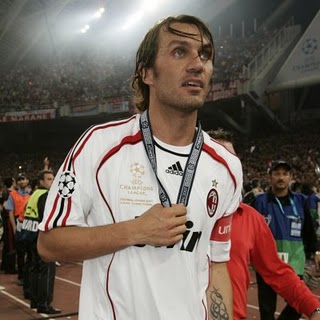
paolo maldini
legenda milan

nah, ini profil nya:
Nama : Paolo maldini
Lahir : 26/06/1968 (Milan)
Posisi : Defender
Height : 1.86m
Weight: 83 Kg
Negara: Italy
Pertandingan professional pertama melawan : Udinese – Milan : 1-1 on 20/01/1985 Kostim yang pernah dipakai AC MILAN:

kostim
kostim
daftar juara yang pernah di dapat :
Seri A:
Juara (17): 1901; 1906; 1907; 1950-51; 1954-55; 1956-57; 1958-59; 1961-62; 1967-68; 1978-79; 1987-88; 1991-92; 1992-93; 1993-94; 1995-96; 1998-99; 2003-2004
Seri B:
Juara (2): 1980–81; 1982–83
Copa Italia:
Juara (5): 1966–67; 1971–72; 1972–73; 1976–77; 2002-03
Runner-up (7): 1941–42; 1967–68; 1970–71; 1974–75; 1984–85; 1989-90; 1997-98
Piala Super Italia:
Juara (5): 1988; 1992; 1993; 1994; 2004
Runner-up (3): 1996; 1999; 2003
Piala/Liga Champions:
Juara (7): 1962-63; 1968-69; 1988-89; 1989-90; 1993-94; 2002-03; 2006-07
Runner-up (4): 1957-58; 1992-93; 1994-95; 2004-05
Piala Super Eropa:
Juara (5): 1989; 1990; 1994; 2003; 2007
Runner-up (2): 1973; 1993
Piala Winners:
Juara (2): 1967–68; 1972–73
Runner-up (1): 1973–74
Piala Interkontinental / Piala Dunia Antarklub FIFA:
Juara (4):1969; 1989; 1990; 2007
Runner-up (4): 1963; 1993; 1994; 2003
Skuad musim ini :
No. Posisi Nama pemain
1 GK Nélson “Dida” de Jesus Silva
4 DF Kakhaber “Kakha” Kaladze
5 DF Oguchi Onyewu
7 FW Alexandre Pato
8 MF Gennaro Gattuso (Wakil Kapten)
9 FW Filippo Inzaghi
10 MF Clarence Seedorf
11 FW Klaas-Jan Huntelaar
12 GK Christian Abbiati
13 DF Alessandro Nesta
15 DF Gianluca Zambrotta
16 MF Mathieu Flamini
17 FW Gianmarco Zigoni
18 DF Marek Jankulovski
19 DF Giuseppe Favalli
20 MF Ignazio Abate
21 MF Andrea Pirlo
22 FW Marco Borriello
23 MF Massimo Ambrosini ( Kapten)
25 DF Daniele Bonera
30 FW Amantino Mancini (Pinjaman dari klub Inter Milan)
31 GK Flavio Roma
32 MF David Beckham (Pinjaman dari klub LA Galaxy)
33 DF Thiago Emiliano da Silva
40 FW Dominic Adiyiah
44 DF Massimo Oddo
50 GK Fillipo Perucchini (Dari AC Milan Primavera)
51 MF Rodney Strasser
58 FW Simone Verdi
77 DF Luca Antonini
80 FW de Assis Ronaldinho
Pelatih AC MILAN sekarang:

Massimiliano Allegri
Musim 2010/2011, Milan dipimpin oleh Massimiliano Allegri, dengan berbagai pembaruan mulai dari sponsor (bwin.com digantikan Emirates), hingga lini pemain. Di akhir bursa transfer, secara mengejutkan Milan memboyong Zlatan Ibrahimovic dari F.C. Barcelona (dengan opsi pinjaman dan pembelian 24 juta Euro di akhir musim), dan Robinho dari Manchester City.

Risa Wulantika Blogs Copyright © 2013 Flower Garden is Designed by Andre